
Electric Vehicles Are Reshaping Transportation Through Cleaner Technology
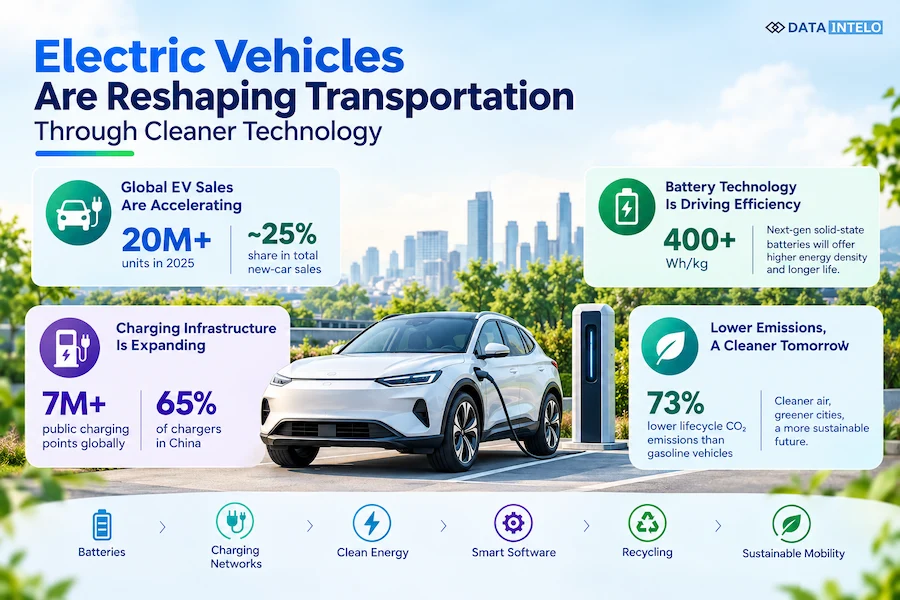
The technology around electric vehicles (EVs) is moving from a niche technology to being mainstream. Electric vehicle sales reached more than 20 million units in 2025, accounting for almost a quarter of all new cars sold.
The bigger picture lies in the shift from burning fossil fuels to the use of electric engines that can become cleaner as electric power generation shifts toward solar cells.
The shift will also lead to changes in vehicle design. Batteries, electric motors, charging systems, software, thermal management, and power electronics are now central elements in vehicle performance.
EV Adoption Is Reaching a Larger Scale
The sales of electric vehicles soared to more than 20 million units in 2025, representing a growth rate of around 20%. Sales in China surpassed 13 million units, and electric vehicle sales accounted for around 55% of new car sales. In Europe, sales increased by almost 30%, reaching over 4 million.
This trend has not been consistent. For example, in 2025, sales outside China, Europe, and the United States were only about 2 million, compared to 1.3 million a year earlier. Consequently, the process of transformation depends on the price of vehicles as well as the availability of many factors, including costs of infrastructure and electricity, depending on the area concerned.
According to Dataintelo, the world’s Electric Vehicle (EV) market was worth about $856.4 billion in 2025, and is projected to grow to $3,801.2 billion by 2034 with an annual growth rate of about 18.2%. The above-mentioned growth can be attributed to the demand for electric mobility in passenger vehicles, public transit, EV charging infrastructure, and related technologies.
Geographical Factors Influencing Electric Vehicle (EV) Utilization
The acceptance of electric vehicles differs in various areas of the world due to various geographical factors. Electric vehicle uptake depends on the cost of the automobile, the condition of the necessary infrastructure, the availability of reliable electrical energy, and driving behavior. By 2025, the sales of electric vehicles in China reached 13 million units, while in Europe the sales reached over 4 million units.
Outside the foremost EV markets, growth is gradual. EV sales in the regions outside China, Europe and the USA stood at 2 million vehicles in 2025, compared to 1.3 million in 2024. The surge in figures indicates the geographical expansion of electrification, though the speed of the process is very different.
Daily driving distance also influences adoption. Urban vehicles that travel 30–60 kilometers per day can often operate with overnight charging, while vehicles covering 200 kilometers or more may require larger batteries or access to faster public charging.
The Technology of Batteries Is Changing the Efficiency of the Vehicles
The battery plays a vital role in EVs. Range, weight, cost, and charging performance all depend upon the process of battery manufacture that has improved energy density while decreasing the volume of materials required for a certain range of driving distance. Lithium iron phosphate batteries have also gained wider acceptance due to lesser dependency on nickel and cobalt, and better battery cycle life.
As of today, rapid changes have significantly affected the battery industry, and global demand for lithium-ion batteries increased significantly by 2025. New advancements with solid-state technologies will lead to new highs in energy density and ensure safer batteries with an energy density over 400 Wh/kg.
The efficiency of the batteries decreases over time due to usage, charging times, and temperature conditions. Battery management systems thus help keep track of all these parameters and optimize batteries’ overall performance.
Impact of Battery Costs on Vehicle Design. Battery technology has repercussions for the performance and price of vehicles. The cost of the electric vehicle can be greatly influenced by a battery pack, which is why augmenting the effectiveness of battery manufacturing technology is important.
The size of the battery is a compromise between various factors. For example, while a 60 kWh battery can provide more usable energy than a 40 kWh battery, its weight is higher, and the materials necessary for its production are more. Car manufacturers need to find a proper balance between the range of the battery and its weight.
Various battery technologies possess distinct characteristics in terms of performance. For instance, lithium iron phosphate technology is being utilized more often because it offers comparable durability at a reasonable price, and relatively high energy density technologies are more applicable in vehicles with lengthy ranges.
📘 Definition
Lithium Iron Phosphate (LFP) is a battery chemistry that trades some energy density for a longer cycle life, better thermal stability, and lower reliance on nickel and cobalt, making it a popular choice for standard-range EVs.
Charging performance can further influence battery requirements. If a vehicle can recover 200–300 kilometers of driving range during a relatively short charging stop, consumers may not need an extremely large battery for every type of journey.
Charging Infrastructure Is Growing
The charging infrastructure forms an important part of the process of improving transportation. By 2025, approximately 7 million chargers were functional worldwide. In 2025, China had more than 4.7 million chargers, which was 65% of chargers operating in the world.
The requirements for charging vary across places like home charging, workplace charging, charging at destination, and highway charging. Home chargers facilitate stable overnight energy supply for people with parking spots, while high-power public charging is more suitable for long trips and for those who cannot use home charging facilities.
Grid Capacity Becomes More Important
The development of electric vehicles and charging facilities makes the connection between transportation and electric infrastructure stronger.
There are several types of charging power that vary in their performance. For instance, a basic home charger can operate at a range of kilowatts, while a high-power public charger can deliver above 100 kW to one vehicle. Thus, a site with 10 high-power chargers may require a bigger electrical connection compared to a residential charging station.
Smart charging plays a vital role in regulating this demand. A vehicle parked at one place for 8 hours does not require charging at maximum power all the time. Thus, smart software has the ability to shift the charging to those times when electricity demand is relatively low.
This is especially important for apartment buildings, workplaces, commercial fleets, and highway charging hubs.
EV Development Indicators
| Indicator | Recent Figure |
|---|---|
| Global electric car sales in 2025 | More than 20 million |
| Electric share of global new-car sales | About 25% |
| Global public charging points at end-2025 | More than 7 million |
| Public chargers added during 2025 | Nearly 1.8 million |
| Global EVs per public charging point | About 11 |
Power Production Impacts Environmental Benefits
Electric vehicles don’t have exhaust emissions when on the road. However, their ecological performance relies on the sources of power and production processes. According to new analyses conducted in Europe, the average battery-driven vehicle sold in 2025 produced around 63 grams of CO2 emissions per kilometer, whereas the same figure for a typical gasoline-powered car is 235 grams — around 73% less.
⭐ Highlight
63g vs. 235g of CO2 per kilometer: even counting the electricity used to charge it, the average EV sold in 2025 produced around 73% less carbon per kilometer than a typical gasoline car.
Battery manufacturing causes higher production emissions initially. Battery cars have about 40% higher production emissions due to production processes compared to gasoline cars. The difference becomes negligible after 17,000 km of distance. When the vehicle is produced using renewable power, emissions are around 52 grams per kilometer.
⚠️ Caution
A higher production footprint doesn’t mean an EV is worse for the climate overall. It just means the emissions savings build up over the vehicle’s mileage rather than showing up on day one.
The electricity mix therefore remains important. An EV charged primarily from lower-carbon electricity can have a different lifecycle profile from one charged using electricity generated predominantly from fossil fuels.
Electric Motors Enhance Energy Conversion
Electric drivetrains are revolutionizing how energy is used to create motion. While conventional internal combustion engines lose considerable energy in the form of heat, electric motors have a much better efficiency in converting electric energy into mechanical power. Regenerative braking allows for recovering energy lost through standard braking systems.
Energy consumption in an electric vehicle is influenced by factors such as weight, speed, weather, road conditions, and the type of motor. Efficiency becomes more important in situations of stop-and-go travel where electric buses, small transportation vehicles, and city fleets are able to recuperate energy during the deceleration process.
Power electronics play a role in efficiency as well. The inverters regulate the flow of electricity between the batteries and electric motors, whereas improved power control can decrease energy loss.
Key Factors Affecting EV Driving Range
The driving range of the electric vehicle is determined by many factors that are not confined to battery size. Some of these influencing factors are speed, temperature, weight of the vehicle, road conditions, and usage of electrical gadgets.
- Speed: Speed impacts aerodynamic drag and the use of energy.
- Temperature: Heating and cooling the battery reduce the range.
- Vehicle Weight: More weight means more energy used in acceleration.
- Regenerative braking: Energy recovery from deceleration.
- Tire pressure: Proper tire pressure minimizes energy needed for rolling.
- Gadgets: Air-conditioning and lighting may increase electricity use.
Enhancement of aerodynamic performance, increased efficiency of the engine, improved thermal management, and optimized energy-control software can help improve distance without increasing the battery capacity.
Expansion of Electric Fleets Beyond Passenger Vehicles
Commercial fleets constitute yet another significant segment to consider in the context of electrification since their travel routes are usually predictable. Goods delivery vehicles, buses, taxis, and corporate vehicles can travel anything from 100 to 250 kilometers daily before they return to their fixed depot.
A delivery vehicle traveling about 150 kilometers during a day of operations can charge more effectively at the depot overnight, thus avoiding the necessity to use public charging facilities during business hours.
Fleet operators also need to consider charging schedules. A depot with 50 vehicles may need to coordinate charging so that all vehicles reach the required battery level before their next departure without creating an unnecessary electricity peak.
The Rise of Electric Trucks and Two-Wheelers
The electrification process has moved beyond a mere passenger car phase. In 2025, worldwide sales of electric trucks went up threefold and reached over 200,000 units. Electric two- and three-wheelers are expanding into developing countries as their daily travel distances are short and, thus, battery-powered vehicles can be employed.
Importance of Software in the Automotive Field
In modern times, much reliance has been placed on software techniques in electric cars. Software takes care of batteries, engines, charging systems, heating management, as well as energy consumption. The battery management scheme checks individual cells, while the control software looks after charging and temperature.
Key software functions include:
- Monitoring battery voltage, temperature, and charge status of cells.
- Making changes in regenerative braking and energy use according to operating conditions.
- Supporting charging controls and vehicle updates through connected systems.
Navigation systems can estimate energy use across a route, while over-the-air updates allow manufacturers to modify certain vehicle functions after delivery. Cybersecurity and reliable electronic control therefore matter more as vehicles become software-defined.
Connected Features Are Changing EV Ownership
Software is also influencing how drivers monitor and use electric vehicles. Connected systems can provide information about battery charge, energy consumption, charging status, and estimated driving range.
Various factors such as speed, temperature, traffic, road elevation, and energy used before can be used in range forecasting. For example, a speed of 100 km/h will use much more energy on a highway compared to moving at 60 km/h in normal traffic.
Charging schedules can also be automated. A vehicle parked for 8–10 hours overnight can be programmed to reach a required battery level before departure rather than continuously charging at maximum power.
This makes it even more critical to have effective software and cybersecurity solutions, as today’s parked cars are full of electronic control systems and they communicate with charging and other services.
Elements Affecting Battery Recycling and Reuse
The growing EV fleet will eventually create more batteries reaching the end of their first automotive service. Recycling can recover materials and reduce the need for some newly extracted resources.
Some batteries may also retain sufficient capacity for stationary storage after vehicle service, although viability depends on battery condition, testing, transportation costs, and recycling economics.
The Next Phase Will Depend on Systems
The development of electric vehicles (EVs) is no longer only assessed by sales figures. It also encompasses elements such as batteries, charging networks, electricity generation, grid capacity, recycling, software, and manufacturing.
By the end of 2025, over 20 million EVs had been sold that year, while the infrastructure for public charging had more than 7 million points throughout the globe.
EVs can significantly lower their lifecycle emissions, but the environmental benefits depend on various factors like sources of electricity, manufacturing processes, durability of batteries, efficiency of the vehicle, and recycling level. Hence, improvements in the energy and mobility system must be made for effective progress in the area.
FAQs
Planning a home or business charger? Find vetted EV charger installers near you.
How many EVs were sold globally in 2025?
More than 20 million units were sold, accounting for almost 25% of all new car sales worldwide.
Which country leads in EV sales?
China leads, surpassing 13 million units in 2025, with EVs making up around 55% of new car sales there.
How many public EV chargers exist worldwide?
Approximately 7 million public chargers were operational by 2025, with China hosting about 65% of them.
Are EVs actually better for the environment?
Yes! EVs average 63g CO2/km versus 235g for gasoline cars, despite higher initial manufacturing emissions.
What battery type is becoming more popular?
Lithium iron phosphate batteries are gaining traction due to lower cobalt/nickel dependency and longer cycle life.

Ashish Kolte is a Marketing Manager at Dataintelo with expertise in marketing, market intelligence, and business strategy. He combines marketing insights with industry research to analyze market trends, identify growth opportunities, and provide data-driven perspectives on emerging industries and global business developments.