
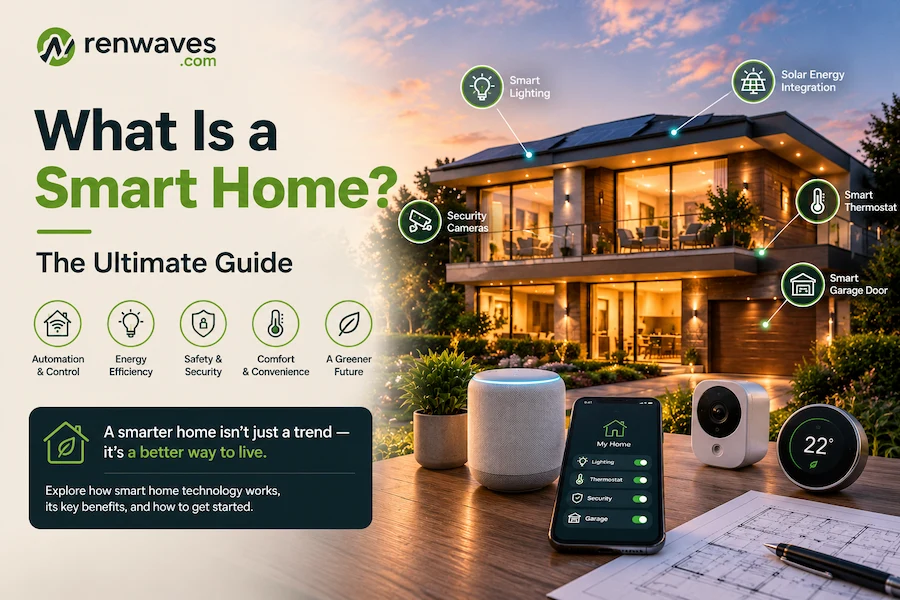
What Is a Smart Home? The Ultimate Guide
A smart home turns your everyday devices, lights, thermostat, locks, and cameras, into one connected system you can control from your phone or your voice. This guide breaks down what a smart home actually is, how it works, and how to start building one.
What Is a Smart Home?
A quick definition before we go further, then we will unpack how the pieces fit together.
📘 Definition
A smart home is a residence where lighting, heating and cooling, security, and appliances are connected to the internet and can be monitored or controlled remotely, often automatically, based on schedules, sensors, or routines.
How Does a Smart Home Work?
Smart homes rely on three layers working together: connected devices, a hub that ties them together, and automation rules that decide what happens and when.
The Smart Hub and Connectivity
A hub, app, or voice assistant links every device on your Wi-Fi, Zigbee, or Z-Wave network so they can talk to each other and to you.
Sensors, Automation, and Routines
Motion, temperature, and light sensors feed data into routines, like dimming lights at sunset or adjusting the thermostat when you leave, so the system reacts without you lifting a finger.
Key Benefits of a Smart Home
The right setup pays off in three main ways: lower energy use, day-to-day convenience, and stronger security.
Energy Efficiency and Lower Bills
Smart thermostats and lighting cut waste by adjusting to occupancy and schedules instead of running at full output all day. Pairing this with your own smart energy technology setup multiplies the savings.
Comfort and Convenience
One app or one voice command replaces a dozen light switches, thermostats, and remotes.
Safety and Security
Cameras, smart locks, and motion alerts let you check on your home and respond in real time, from anywhere.
⭐ Highlights
Biggest win: lower energy bills through automated scheduling.
Fastest payoff: a smart thermostat, usually within one to two years.
Must-Have Smart Home Devices
You do not need to automate everything at once. These are the devices that deliver the most value first.
Smart Lighting
Dimmable, schedulable bulbs and switches cut wasted lighting and set the mood on command.
Smart Thermostats
They learn your schedule and adjust heating and cooling automatically, one of the highest-impact upgrades for energy use.
Smart Security Cameras
Real-time alerts and remote viewing add a layer of protection whether you are home or away.
Solar Energy Integration
Pairing your smart home with solar photovoltaic panels lets you shift automated loads, like charging or laundry, to the hours your panels produce the most.
Here is a quick snapshot of what each device is best at:
| Device | Main Benefit |
|---|---|
| Smart Lighting | Energy savings |
| Smart Thermostat | Lower bills |
| Security Camera | Safety |
| Smart Lock | Access control |
| Smart Garage Door | Convenience |
| Solar Integration | Clean power |
How to Get Started with a Smart Home
Start small, stay compatible, and scale up as you see what actually helps.
Start with One Room
Pick one space, usually the living room or bedroom, and automate lighting or climate there first.
Pick a Compatible Ecosystem
Choose devices that work with the same app or voice assistant so they do not end up on separate, disconnected apps.
Pair Smart Tech with Renewable Energy
Once your automation is in place, adding smart energy technology lets your home run more of its automated tasks on power you generate yourself.
💡 Tip
Buy one device at a time and test it for a week before adding the next. This makes it easy to spot what is actually saving you money.
⚠️ Warning
Not all smart devices speak the same protocol. Check that a device supports your hub or voice assistant before you buy, or you may end up with gadgets that cannot talk to each other.
Conclusion
A smart home is not about owning every gadget on the market. It is about connecting the few devices that actually save you energy, time, or peace of mind, then building on that foundation. Start with lighting or a thermostat, stay within one ecosystem, and pair it with smart energy technology for the biggest long-term payoff.
FAQs
Ready to take the next step? Plan your system with our smart home design service, then find vetted installers near you to build it.
What is the simplest definition of a smart home?
A home where devices like lights, thermostats, and locks connect to the internet so you can control or automate them remotely.
Do I need a hub to have a smart home?
Not always. Many devices connect directly to Wi-Fi and an app, but a hub makes it easier to link devices from different brands into one system.
What is the best smart home device to start with?
A smart thermostat or smart lighting usually gives the fastest, most visible payoff in energy savings.
Does a smart home actually save energy?
Yes. Automated scheduling and occupancy sensing cut wasted heating, cooling, and lighting compared to manual control.
Can a smart home work with solar panels?
Yes. Smart systems can shift automated tasks, like charging or laundry, to the hours when your solar panels produce the most power.

I’m an engineer specializing in renewable energy technologies, with a master’s degree in mechanical engineering and research focused on thermo-photovoltaic systems. I’ve contributed to ISI journals, presented at international conferences, and written for industry publications, sharing insights on sustainable energy solutions.
