
What Is Photovoltaics? How Does a Solar Cell Work?
Photovoltaic modules are becoming increasingly cost-effective and more attractive to both people and governments.
The efficiency of solar cells has significantly increased in recent decades, leading to a huge capacity of installed modules. But many people still have doubts about using this renewable technology.
In this article, we’ll explain what photovoltaics is and how it works. We’ll also list its pros and cons so that you can decide better about using PV systems in your homes and businesses.
What Is Photovoltaics?

📘 Definition
Photovoltaics is a physical phenomenon that involves converting sunlight directly into electricity using specific materials, like silicon.
The word “photovoltaics” has a Greek root and combines two ideas: photo, which is related to light, and voltaic, which is about voltage.
In 1839, French physicist Alexandre-Edmond Becquerel discovered the photovoltaic effect. However, the first solar cell was made a long time later.
Now, photovoltaics is one of the fastest-growing fields of technology and is revolutionising the way we generate and consume electricity.
Many people confuse photovoltaics, solar cells, solar collectors, and PV modules. Here’s a simple guide to understanding the differences between them:
- Photovoltaics: The technology/science of converting sunlight directly into electricity.
- Photovoltaic: Any item related to photovoltaics, such as a photovoltaic cell or system.
- Solar cell: An integrated semiconductor device that converts sunlight directly into electricity.
- Solar thermal collector: A device that absorbs sunlight’s radiative energy to produce heat, not electricity.
- PV module: A group of connected solar cells to make a single unit. It’s usually called a solar panel.
How Does a PV System Work?
As said earlier, photovoltaic technology uses sunlight energy to generate electrical current.
Solar cells usually include a junction between n-type and p-type semiconductors. When sunlight reaches the junction, photons with enough energy can excite electrons and make them travel through the junction.
So, an electric current is generated by photons. Obviously, this electricity is direct current (DC), which is different from your home’s electric current.
Most of your appliances operate using AC electricity that is usually generated using rotary turbines.
In other words, a solar cell is a direct energy conversion device and is one of the most ingenious technologies to generate power directly within a material.
📘 Definition
A PV system is usually made of multiple solar panels (each of which has multiple solar cells).
The electricity generated by panels goes to an inverter to become alternating current suitable for your appliances.
Sometimes, you need to store the electric power to use later (for example, at night). As a result, you need a solar battery for storage and a charge controller to switch the current between the battery and the inverter.
Here is a quick overview of a simple solar photovoltaic system and how it works:

| Component | What it does |
| Solar cell | Converts sunlight into electricity |
| PV module | Combines multiple solar cells into a practical panel |
| PV array | Combines multiple modules to increase system power |
| Inverter | Converts DC electricity into AC electricity |
| Mounting system | Supports and positions PV modules |
| Battery | Stores electrical energy for later use when included |
| Monitoring system | Measures system output and operating conditions |
| Safety equipment | Provides switching, isolation, and protection |
Pros & Cons of Photovoltaic Systems
Each energy system has its own benefits and drawbacks. Let’s see if the advantages of photovoltaics outweigh the disadvantages:
Advantages of Photovoltaics
⭐ Highlight
PV systems provide clean, renewable electricity with no fuel or moving parts. They are scalable, long-lasting, low-maintenance, easy to install, reduce energy bills, and can generate income.
- Renewable energy source: Sunlight is continually regenerated. So, we can hope to have it for our entire lifespan.
- Zero fuel: Solar cells do not need a continuous fuel supply to generate electricity.
- Low emissions: Electricity generation from PV modules does not pollute the air and is environmentally friendly.
- Scalable: You can install solar panels ranging from small installations to utility-scale power plants.
- Modular: It’s possible to change the capacity of your system by adding modules and equipment.
- Grid-independent: Your home’s dependence on grid electricity will decrease when using PV modules.
- Bill reduction: You can schedule using solar electricity when the grid power price is at its maximum and save money.
- Passive income: You can sell extra electricity to the grid and earn extra money.
- Long lifespan: PV modules usually work for 25 years.
- Low routine maintenance: You just need to clean the surface of solar cells.
- Easy installation: It’s possible to install solar modules on rooftops, ground-mounted structures, parking canopies, façades, and other suitable surfaces.
- No moving parts: Electricity is produced by the material itself without using rotating machinery.
Disadvantages of Photovoltaics
⭐ Highlight
Solar generation depends on sunlight and weather, requires upfront investment and suitable space, and becomes less efficient at high temperatures. Output gradually degrades, while batteries and end-of-life recycling can add costs.
- Intermittent generation: Solar cells’ output varies with sunlight and falls to zero at night.
- Weather dependence: Clouds and other atmospheric conditions can reduce solar cells’ output.
- Upfront investment: Purchasing and installing a complete system might be significant for many families.
- Space requirements: A significant amount of area may be required for larger systems.
- Temperature effects: The efficiency of PV modules decreases as their operating temperature rises.
- Performance degradation: The output of photovoltaic modules gradually declines over time.
- Battery cost: Storage can significantly increase the initial cost of your PV project.
- End-of-life management: PV modules and other equipment require an effective reuse, recycling, or disposal system.
Types of Solar Cells
Here are categories of solar cells:

1. Crystalline Silicon Solar Cells
These are the most common solar cells in the market at the moment.
Monocrystalline Silicon
Monocrystalline silicon cells are manufactured from high-purity crystalline silicon structures. A single structure, which is usually cubic, repeats throughout the entire body of a monocrystalline solar cell.
The efficiency of monocrystalline solar cells is higher than that of other solar cell types. They are widely used in residential, commercial, and utility-scale modules.
Polycrystalline Silicon
Polycrystalline silicon cells are made of multiple crystal structures instead of one continuous form.
The process of manufacturing them is cheaper, but their efficiency is significantly lower than that of single-crystal cells.
2. Thin-Film Solar Cells
Thin-film photovoltaic cells have a different structure. They use very thin semiconductor layers deposited onto a substrate.
Common thin-film technologies are:
- Cadmium telluride (CdTe)
- Copper indium gallium diselenide (CIGS)
- Amorphous silicon (a-Si)
3. Emerging Technologies
Fortunately, some new technologies are emerging in the world of solar cells that will revolutionize the market in the future.
Here are some examples:
Perovskite Solar Cells
Perovskites are a fast-growing family of semiconductor materials. Perovskite is a special type of crystal material with a particular atomic structure.
In solar cells, the perovskite layer is usually made from a mixture of elements such as:
- Lead (Pb): helps with light absorption.
- Iodine or bromine: part of the crystal structure.
- Organic or inorganic molecules such as methylammonium or cesium.
They have great potential for reaching high efficiencies at lower prices compared to traditional cells.
Tandem Solar Cells
Tandem cells combine two or more light-absorbing semiconductor structures so that different portions of the solar spectrum can be used more effectively.
Here is a quick comparison between different types of solar cells:
| Solar Cell Type | Typical Efficiency | Cost | Main Advantages | Main Limitations |
| Monocrystalline Silicon | 20–24% | Medium–High | High efficiency | Higher cost |
| Polycrystalline Silicon | 15–18% | Low–Medium | Lower cost | Lower efficiency |
| CdTe Thin-Film | 18–22% | Low–Medium | Low material use | Cadmium toxicity |
| CIGS Thin-Film | 15–20% | Medium | Lightweight; flexible options | Complex manufacturing |
| Amorphous Silicon (a-Si) | 6–12% | Low | Lightweight; flexible | Very low efficiency |
| Perovskite | ~20–26% | Potentially Low | Very high potential | Stability issue |
| Tandem | ~25–35%+ | High | Very high efficiency | Complex structure |
Types of Photovoltaic Systems
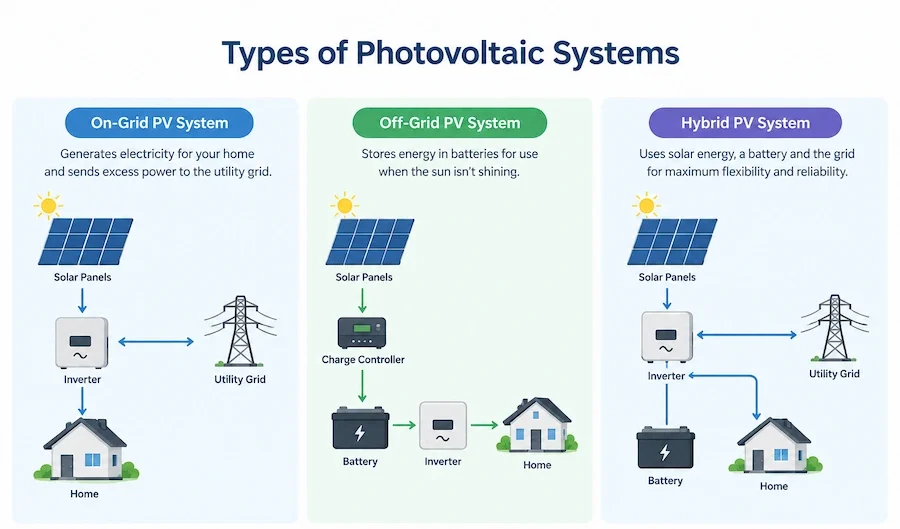
PV systems are used in three main methods:
⭐ Highlight
PV systems are mainly grid-connected, stand-alone, or hybrid. Grid-connected systems operate with the utility grid, stand-alone systems operate independently with energy storage, and hybrid systems combine PV, storage, and typically the grid.
1. On-Grid PV Systems
It’s a grid-connected system that imports/exports power from/to the electrical utility grid.
So, when your PV panels generate electricity, you can use it without relying on grid power. Otherwise, you can use grid power when you don’t have solar electricity.
You can also design it so that you can export the extra solar power generated by your panels to the grid depending on your local regulations.
This type of system doesn’t guarantee solar power whenever you want. However, it has a lower initial cost compared to other types of PV systems.
2. Off-Grid PV Systems
An off-grid system can operate without a utility-grid connection. If you want an off-grid system, you typically need:
- More PV modules
- Charge-control or inverter equipment
- A huge storage system
- Extensive electrical protection
- Energy-management equipment
The cost of such a system is definitely higher than that of on-grid systems.
3. Hybrid Solar Systems
A hybrid PV system combines solar generation with energy storage. Also, it usually offers a grid connection or another backup source.
This configuration allows you to use solar electricity, store excess production, and schedule the solar system based on peak usage hours.
Photovoltaic Cost: A Simple Estimation
You can use a photovoltaic system in different applications:
| Category | Type | Typical application |
| Residential PV | Residential Solar | Homes and small buildings |
| Commercial PV | Commercial Solar | Offices, retail, factories, institutions |
| Utility-Scale PV | Solar Farms | Large-scale electricity generation |
| Building-Integrated PV | BIPV | PV integrated into building components |
Depending on your requirements and the quality of your equipment, the project cost can vary significantly.
Apart from your system capacity, you need to consider the following when calculating the cost of your PV system:
- PV modules: Major hardware component and source of generation
- Inverter: Converts and manages electrical power
- Mounting: Attaches modules safely to the building or ground
- Electrical equipment: Provides protection, isolation, switching, and connection
- Labor: Installation and commissioning costs
- Engineering/design: System sizing and technical design
- Permits/grid connection: Depends heavily on location
- Roof work: Can add substantial cost if repairs are required
- Battery: Can significantly increase total project cost
- Monitoring: Tracks production and system health
To get familiar with the costs of a typical PV system, it’s good to look at the following sample:
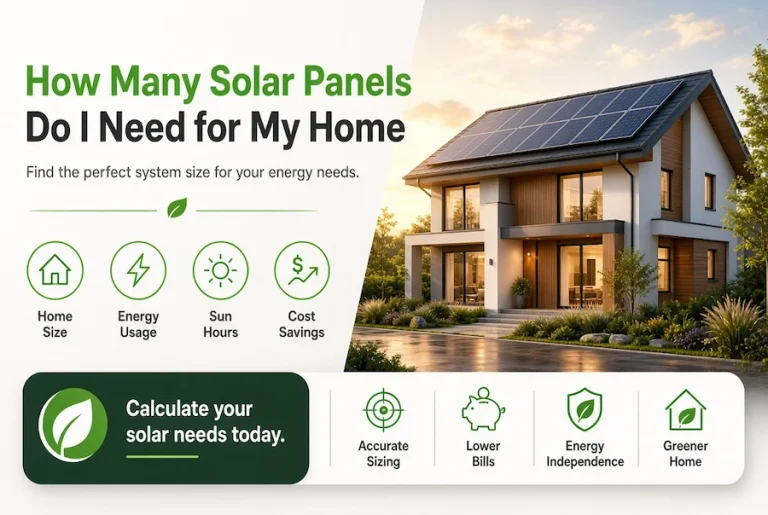
Imagine you have a villa that uses about 15 kWh of electricity per day. We can assume that the location gets around 5 peak sun hours per day.
Here is a summary of the calculation you need:
| Design step | Simple Formula | Result |
| Estimated villa consumption | — | 15 kWh/day |
| Peak sun hours | Assumption | 5 h/day |
| Initial PV size | 15 ÷ 5 | 3 kW |
| Allowance for system losses | 3 ÷ 0.80 | 3.75 kW |
| Rounded system size | — | ≈ 4 kW |
| Panel size | Assumption | 500 W |
| Number of panels | 4 ÷ 0.5 | 8 panels |
| Total panel capacity | 8 × 500 W | 4 kW |
So, as a simple starting point, this villa would need about eight 500 W solar panels. We can now calculate the cost of your PV system considering the average prices on the market:
| Component | Estimated Cost |
|---|---|
| ☀️ 8 × 500 W PV panels | $1,000–$1,400 |
| ⚡ 4–5 kW hybrid inverter | $1,000–$1,800 |
| 🔋 10 kWh lithium battery | $2,500–$4,000 |
| 🔩 Mounting structure | $400–$700 |
| 🔌 Cables & protection equipment | $300–$500 |
| 👷 Installation & labor | $1,000–$2,000 |
| Estimated total | ≈ $6,200–$10,400 |
💡 Tip
If you don’t want solar power at night, you can omit batteries and some other tools and reduce the cost to $2,500 – $4,000.
Need to size your home’s PV system? Use our free solar PV calculator.
Final Thoughts
Photovoltaics is the effect of electron excitation and flow through a p-n junction by a photon. This phenomenon is the foundation of a large industry that is changing the face of our lives and businesses. Photovoltaic systems have attracted the attention of governments, people, and environmentalists. Solar systems’ size varies from several watts to gigawatts. You can easily install photovoltaic panels on your home’s roof and reduce your electricity bill. You can also export power to the grid depending on your local regulations. If you need advice on the calculation and installation of a PV system, you can count on our help.
FAQs
Is it worth adding solar panels to my home?
It can be, especially if you have good sunlight, suitable roof space, and relatively high electricity costs. Your savings depend on system cost, electricity use, local solar conditions, incentives, and whether you need battery storage.
How much is the efficiency of solar cells?
Modern commercial solar modules typically have efficiencies of roughly 18–25%, depending on the technology and product. Laboratory cells can achieve much higher efficiencies, but those records do not represent typical residential panels.
What’s the difference between solar cells and photovoltaic modules?
A solar cell is the individual device that converts sunlight into electricity. A PV module combines many solar cells into one complete, protected panel.
How much do PV modules cost?
Prices vary by efficiency, technology, brand, size, and market. Module-only prices are much lower than the total cost of an installed PV system, which also includes the inverter, mounting, wiring, labor, and other equipment.
What is the difference between a solar collector and photovoltaics?
Photovoltaics converts sunlight into electricity, while a solar thermal collector converts sunlight into heat.
What is photovoltaics?
Photovoltaics is the direct conversion of sunlight into electricity using a p-n semiconductor junction.

I’m an engineer specializing in renewable energy technologies, with a master’s degree in mechanical engineering and research focused on thermo-photovoltaic systems. I’ve contributed to ISI journals, presented at international conferences, and written for industry publications, sharing insights on sustainable energy solutions.