
How Many Solar Panels Do I Need for My Home?
One of the greatest advantages of solar energy is its simplicity to install and use. Many homeowners search for DIY tips for calculating and installing solar panels.
Although we recommend getting expert advice and collaborating with seasoned installers, we can help you size your solar system and install it by yourself.
This blog post provides a beginner-friendly guide to answer your question of “how many solar panels do I need for my home?”
We’ll try to provide simple rule-of-thumb formulas for different scenarios to help you estimate how many PV panels your building needs.
You can also use our online solar sizing calculator to ensure your calculation is correct.
Key Factors to Consider for Solar Panel Calculation
Many factors impact the efficiency of your PV system and the required number of panels.
The most important factors are:
| Factor | Effect |
| Consumption | The more annual electricity, the more PV panels |
| Solar resource | The more sunlight, the fewer PV panels |
| Location | Impacts solar radiation, temperature, and seasonal production |
| Panel wattage | The higher the wattage, the fewer PV panels |
| Panel efficiency | The higher the efficiency, the fewer PV panels |
| System losses | Inverter, wiring, and soiling can increase the number of panels |
| Roof orientation | Affects how much sunlight reaches the array |
| Roof tilt | Influences annual and seasonal solar production |
| Shading | Reduces production and increases PV panels |
| Roof area | Limits how many panels you can physically install |
| Battery storage | Saves energy and changes how the PV system is operated |
| Grid connection | Fills the gap between PV production and consumption |
Your electricity consumption and local solar resource usually have the greatest influence on the initial calculation.
Moreover, the type of system you choose, including grid-connected or off-grid, can change your calculations.
How Many Solar Panels Do I Need for My Home: A Simple Formula
Unfortunately, calculating the required number of solar panels can be a very difficult task. There are many methods for estimating solar energy and PV efficiency.
Look at the following table to compare various PV calculation methods:
The first method is the easiest technically consistent approach to calculate the required PV capacity in kW. Then, you need to convert that capacity into several panels.
The basic formula for estimating PV capacity in kW is:
📐 Formula
Required PV Capacity (kW) = Annual Electricity Consumption (kWh) ÷ Specific PV Production (kWh/kW/year)
Then, the number of solar panels is:
📐 Formula
Number of Solar Panels = Required PV Capacity (kW) ÷ Panel Power (kW)
What Is Specific PV Production?
In the formula, you see an important parameter called “Specific PV Production”. It tells you how much electricity your PV system can produce each year for every 1 kW of installed capacity.
In fact, the nominal power the panel manufacturer claims can not be obtained in reality. Many factors impact your panels’ performance and make them generate less power, including:
| Category | Main factors |
| Solar resource | Irradiation, climate, weather, location |
| System design | Tilt, orientation, shading, array layout |
| Equipment | Module efficiency, inverter efficiency, module technology |
| Losses | Temperature, soiling, wiring, mismatch, inverter losses |
| Environment | Snow, dust, pollution, humidity |
| Long-term performance | Module degradation, equipment availability |
For example, suppose you’re installing a 5 kW PV system in a location with an estimated specific production of 1,500 kWh/kW/year.
So, your PV system will produce approximately 5 × 1,500 = 7,500 kWh/year.
Here is how to estimate Specific PV Production for your system (kWh/kW/year):
- Excellent solar resource: 1,600 – 2,000+
- Good solar resource: 1,300 – 1,600
- Moderate solar resource: 1,000 – 1,300
- Low solar resource: 700 – 1,000
Overall, you can continue your calculation using a value between 1,300 and 1,600.
A Sample Calculation
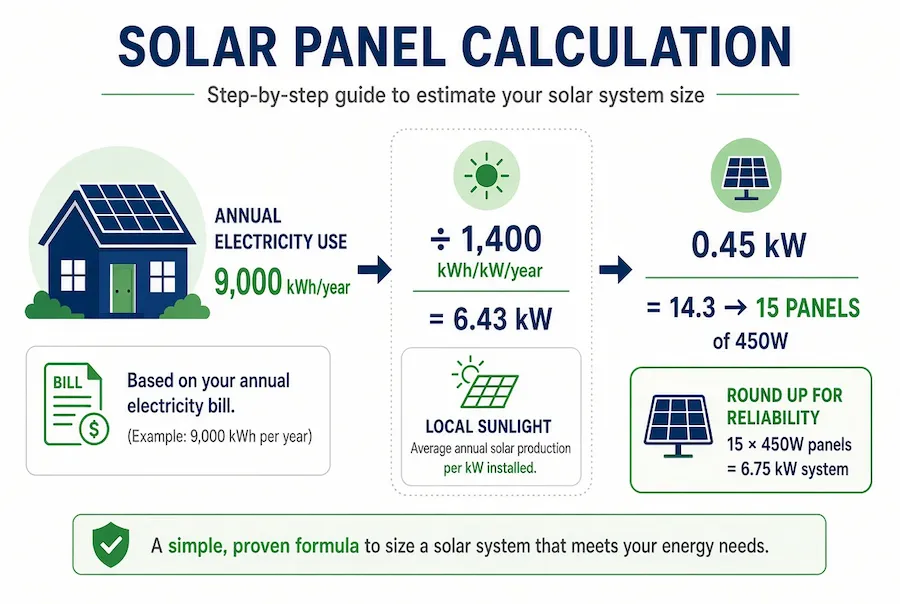
Imagine your home uses 9,000 kWh of electric power each year (you know this number from your bills).
And your location can produce approximately 1,400 kWh/kW/year.
Then:
Required PV capacity = 9,000 ÷ 1,400 = 6.43 kW
Now assume you have 450 W panels. So, the number of panels is:
Panel count = 6.43 ÷ 0.45 = 14.3
Since you cannot install 14.3 panels, you would need approximately:
⭐ Highlight
The Number of Solar Panels: 15
Solar System Sizing Examples for Different Scenarios
We already calculated the number of PV panels required for a typical house.
Here, we want to see how the type of system impacts your system design, including the number of solar panels and batteries.
A grid-tied system relies on the utility grid when solar production is low. On the other hand, an off-grid system must generate and store enough energy to power your home without grid electricity.
To make the comparison easier, we can use the same example:
| Assumption | Example value |
| Annual electricity consumption | 9,000 kWh/year |
| Average daily consumption | 24.7 kWh/day |
| Specific PV production | 1,400 kWh/kW/year |
| Solar panel rating | 450 W |
| Example panel area | ~2.1 m² |
| Battery usable capacity | Depends on system |
| Battery depth of discharge | 80% |
| Grid available | Depends on scenario |
Here is a detailed design for three scenarios:

1. A Grid-Tied PV System (Without Battery)
A grid-tied system is connected to the grid. So, it can send power to the grid when you have more PV electricity generated than you need. Also, you can get power from the grid when your PV system doesn’t generate enough electricity.
This is the simplest of the three configurations. The solar panels generate electricity during the day, while the grid supplies electricity whenever PV production is insufficient.
In this system, even if you install fewer panels, you won’t face problems. A grid-tied system does not necessarily have to produce every kWh at the exact time the home consumes it.
For example, your PV system might generate more power than you need at noon and export it to the grid. Then, you can consume it later at night or in winter from the grid.
But here we want to calculate how many solar panels you need to power your house’s annual consumption.
We already calculated the required number of panels for such a system. Here are more details of what you need for this system:
| Equipment | Example specification | Purpose |
| Solar panels | 15 × 450 W | 6.75 kW DC PV array |
| PV inverter | ~6 kW grid-tied inverter | Converts DC to AC and synchronizes with the grid |
| Battery | None | Not required |
| DC protection | DC isolator + overcurrent protection as required | PV-side protection |
| AC protection | AC breaker/isolator + surge protection | AC-side protection |
| Monitoring | Inverter monitoring system | Tracks production |
| Grid connection | Utility connection/metering equipment | Supplies electricity when PV is insufficient |
The main advantage of this configuration is its simplicity and lower equipment requirement. However, grid-tied systems do not provide backup power during a grid outage.
2. A Hybrid PV System (Battery + Grid)
📘 Definition
A hybrid solar system combines solar panels, a battery, a hybrid inverter, and the electrical grid.
In fact, its purpose is to provide the best of both worlds: battery support + grid support.
The grid is available when solar and battery power are insufficient. However, the battery allows you to store the daytime solar energy when it’s more than your usage and use it later.
This has two main advantages:
- You have electricity during a grid outage
- You pay less for electricity because you have solar storage
You can calculate the required PV panels based on the same annual-energy calculation. Consider the same home:
Required PV Capacity = 9,000 ÷ 1,400 = 6.43 kW
If you use 450 W panels, the number of panels will be:
6.43 ÷ 0.45 = 14.3 panels
Therefore, we again round up to:
15 × 450 W = 6.75 kW PV
In fact, there is no significant difference in the number of batteries in this strategy. You just want to store the extra electricity for grid outages or peak hours to reduce bills.
So, the battery is the only difference. In a hybrid system, the amount of battery storage depends on the owner’s budget. The more battery you use, the less dependence on grid power you have.
Suppose you want approximately 8 kWh of usable battery energy for evening use or backup. If the battery is designed around an 80% usable depth of discharge, you need:
Required Nominal Battery Capacity = Usable Capacity ÷ Depth of Discharge
= 8 ÷ 0.80 = 10 kWh
⚠️ Caution
Note that the backup duration depends on your consumption. You’d better avoid using appliances like air conditioners because the battery’s power will be consumed quickly.
Here is a quick overview of a hybrid system:
| Equipment | Example specification | Purpose |
| Solar panels | 15 × 450 W | 6.75 kW DC PV array |
| Hybrid inverter | ~6–8 kW | Manages PV, battery, loads, and grid |
| Battery | ~10 kWh nominal | Stores excess solar energy |
| Usable battery energy | ~8 kWh | Energy available at 80% DoD |
| Battery technology | LiFePO₄ lithium battery, for example | Common residential storage option |
| Battery protection | Battery fuse/breaker and disconnect | Battery-side protection |
| DC protection | PV isolator/overcurrent protection | PV-side protection |
| AC protection | Breaker, isolator and surge protection | AC-side protection |
| Backup/load panel | Dedicated essential-load panel | Supplies selected loads during outages |
| Monitoring | Inverter/battery monitoring | Tracks PV, battery, grid, and load |
| Grid connection | Utility connection | Backup energy source |
The important point is that PV sizing and battery sizing are two different calculations. The PV array determines how much solar energy you can generate. On the other hand, the battery determines how much energy you can store to use later.
In a hybrid system, you have more flexibility in changing the sizes depending on your objectives.
3. An Off-Grid PV System (With Battery)
An off-grid system is totally different because there is no utility grid to support you when solar production is low.
So, your PV panels and battery storage must provide enough energy for the home’s daily consumption.
It should charge the battery, handle peak loads, and provide enough storage to have electricity when you have poor solar production.
Consider the same home:
9,000 ÷ 365 ≈ 24.7 kWh/day
For a simplified off-grid calculation, assume:
- Average peak sun hours = 4 hours/day
- Overall PV system performance factor = 75%
- Daily energy requirement = 24.7 kWh
So, the approximate PV capacity can be estimated as:
Required PV Capacity = Daily Energy ÷ (Peak Sun Hours × Performance Factor)
= 24.7 ÷ (4 × 0.75)
= 8.23 kW
Using 450 W panels, you should consider:
8.23 ÷ 0.45 = 18.3 ~ 19 Panels
So, the initial design needs:
19 × 450 W = 8.55 kW of PV
As you can see, this is considerably larger than the 6.75 kW array used in our grid-tied example.
The reason is simple: your off-grid system cannot depend on the utility grid when solar production falls short.
Now, it’s time for battery sizing.
The battery also needs to be substantially larger than the hybrid example.
As a simple assumption, we can approximately consider one day of usable storage for your home’s average consumption:
Required usable battery capacity ≈ 24.7 kWh
With an assumed 80% depth of discharge:
Nominal Battery Capacity = 24.7 ÷ 0.80
≈ 30.9 kWh
So, as a simplified starting point, you can consider an approximately 30-32 kWh nominal battery bank.
Remember that this calculation was based on a single-day storage assumption. If in your region, you have multiple days of cloudy weather, you’ll have a considerably larger system.
Here is a summary of what you need:
| Equipment | Example specification | Purpose |
| Solar panels | 19 × 450 W | 8.55 kW DC PV array |
| Off-grid/hybrid inverter | ~8 kW continuous output | Supplies AC loads and manages PV/battery |
| Battery | ~30–32 kWh nominal | Stores energy for periods without sunlight |
| Usable battery energy | ~25 kWh at 80% DoD | Approximately one average day of storage |
| Battery technology | LiFePO₄ lithium battery, for example | Residential energy storage |
| MPPT charge controller | Integrated or appropriately sized external MPPT | Converts PV energy for battery charging |
| DC protection | PV disconnects, fuses/breakers and surge protection as required | PV-side protection |
| Battery protection | Battery disconnect and overcurrent protection | Protects battery circuit |
| AC distribution | Main and branch protection | Distributes power to household loads |
| Monitoring system | Inverter/battery monitoring | Tracks PV, battery, and load performance |
You also need to size your inverter carefully. An important point about the inverter is that it should be able to cover short surges when motor-driven appliances like compressors or pumps start to run.
Comparing the Three Solar System Designs
Until now, we have understood that there is no single answer to the question “How many solar panels do I need?”
The answer depends on your budget, requirements, objectives, and the system you choose for your home.
Here is a quick comparison between these systems:
| Item | Grid-Tied | Hybrid | Off-Grid |
| Annual household consumption | 9,000 kWh | 9,000 kWh | 9,000 kWh |
| Average daily consumption | 24.7 kWh | 24.7 kWh | 24.7 kWh |
| Example PV capacity | 6.75 kW | 6.75 kW | 8.55 kW |
| 450 W panels | 15 | 15 | 19 |
| Battery | None | ~10 kWh | ~30–32 kWh |
| Approx. usable battery | — | ~8 kWh | ~25 kWh |
| Inverter | ~6 kW grid-tied | ~6–8 kW hybrid | ~8 kW off-grid/hybrid |
| Grid connection | Yes | Yes | No |
| Backup during outage | Generally no | Yes, for selected loads | Yes |
| Excess solar storage | No | Yes | Yes |
| Dependence on grid | High | Moderate | None |
| Need to consider poor-weather periods | Lower | Moderate | High |
| System complexity | Low | Medium | High |
If you need more advice on choosing the right PV system and calculating the number of PV panels, you can count on our help.
Roof Space Calculation for Solar Panels

One of the most important factors that limits the number of panels you can install is your roof space.
You have to make sure that your panels can be physically fit on your roof without shading. Here is the simplest formula for estimating the required roof area:
Required Roof Area ≈ Number of Panels × Area of One Panel
For example, suppose your panels’ surface area is 1.1 m × 2.0 m = 2.2 m². So, for 15 panels, you need approximately 15 × 2.2 = 33 m².
Of course, many times you have obstacles like:
- Chimneys
- Skylights
- Roof vents
- HVAC equipment
- Roof edges
- Different roof planes
- Walkways
- Maintenance access
- Shading
- Required clearances
- Structural limitations
So, a roof’s total area is different from its usable solar area.
| Number of Panels | Approx. Panel Area | Practical Meaning |
| 6 | 13.2 m² | Small array |
| 10 | 22.0 m² | Moderate array |
| 15 | 33.0 m² | Typical medium residential array |
| 20 | 44.0 m² | Larger residential array |
| 25 | 55.0 m² | Large residential array |
The Number of Solar Panels Based on Home Size
We calculated the number of solar panels based on your electricity consumption in a year. Many times, homeowners don’t know their annual consumption. If you’re one of those, you’re in the right place.
Here, we’ll offer a simple method to estimate the required number of solar panels based on your home’s size.
Please bear in mind that square footage does not directly determine electricity consumption. Your lifestyle and the appliances you use are more impactful than the size of your home.
However, we can estimate based on average electricity consumption:
Solar sizing estimate
How many panels does your home need?
Move the slider to your home's square footage. We'll estimate a typical annual electricity use for a home that size, then translate that into a system size and panel count.
These numbers are a starting estimate, not a system design. Square footage doesn't directly determine electricity use, your lifestyle, occupancy, and appliances (especially AC, EVs, and electric heating) matter more than floor area. Talk to an installer for an assessment based on your actual usage and roof.
You should not consider these numbers a perfect sizing, but an estimate.
Final Thought
Depending on your requirements, there are other methods for calculating the number of solar panels for your home. Here, we’ve summarized these methods:
| Method | Simple Formula / Basis | Best For |
| Annual Consumption | Annual kWh ÷ annual output per panel | Accurate sizing |
| Daily Consumption | Daily kWh ÷ daily output per panel | Quick estimate |
| Monthly Bill | Monthly kWh ÷ monthly panel output | Using utility bills |
| System Capacity | System kW ÷ panel kW | Known system size |
| Roof Area | Usable roof area ÷ panel area | Space check |
| Peak Load | Required energy ÷ panel output | Backup systems |
| Appliance Load | Appliance energy ÷ panel output | Off-grid homes |
We provided some useful estimates of PV system size. Of course, you can’t rely solely on them when sizing your own system.
You’d better get advice from experts and work with professional installers near your home. However, if you’re good at practical jobs, you can do it yourself (DIY), and we can help you in this regard. So, don’t hesitate to contact us.
FAQs
How many solar panels to run a normal house?
Most US homes need about 15-20 panels (350-450W each) to cover average annual usage, though it ranges roughly 10-25 depending on home size and consumption.
How much solar for 1 AC?
A typical central AC unit (3- 4 tons) draws about 3,000-5,000 watts running, so you'd need roughly 3-5 panels (450W) just to offset it while it's running, more if you want to cover its full daily runtime.
Can 4 solar panels power a house?
Not a whole house on average. Four 450W panels produce about 1.8 kW, enough for a few small appliances or partial offset, not full household consumption.
What is the 20% rule for solar panels?
It refers to sizing your solar battery or inverter with about 20% extra capacity above your calculated needs, as a buffer for future usage growth, inefficiencies, or panel degradation over time.

I’m an engineer specializing in renewable energy technologies, with a master’s degree in mechanical engineering and research focused on thermo-photovoltaic systems. I’ve contributed to ISI journals, presented at international conferences, and written for industry publications, sharing insights on sustainable energy solutions.