Renewable Energy 2027: Growth, Opportunities, and Challenges Ahead
The impact of Renewable energy on our lives is increasing day by day. In this article, we’ll try to review renewable energy 2027 to help you make better decisions in your projects or investments in renewable energy.
Highlights
Solar + wind
Main growth engines
Storage + grids
Key to reliable supply
Hydro + geothermal
Flexible, firm power
Main risks
Grid delays, costs, policy
Energy outlook · 2027
Renewable Energy in 2027: Growth, Opportunities, and Challenges Ahead
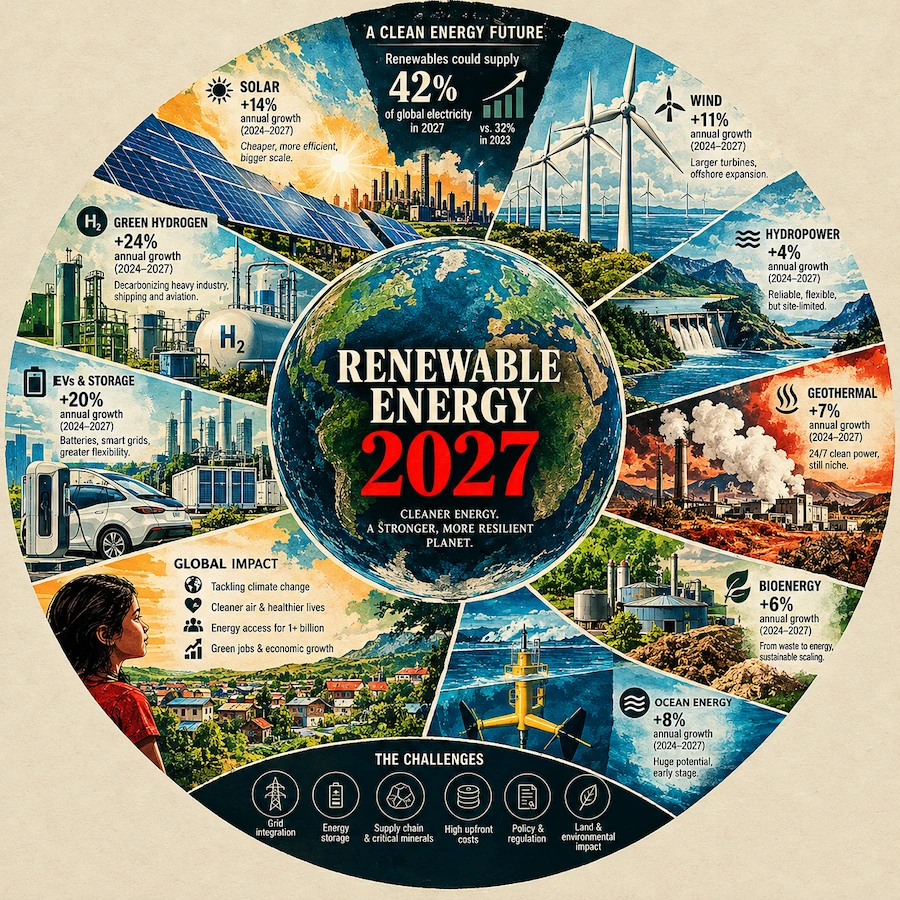
Renewable energy is set to keep expanding in 2027. Solar and wind are growing, while storage and grid upgrades will help determine how much clean electricity reaches consumers.
The IEA forecasts that renewables could provide about 37% of global electricity in 2027. This remains a projection, shaped by policy, weather, investment, and grid capacity.
Here are the key technologies, opportunities, and barriers to watch.
IEA forecast for global electricity generation in 2027.
Reported estimate in the IEA’s 2026 review; a historical figure, not a 2027 forecast.
Sources: IEA Electricity Mid-Year Update 2026 and IEA Global Energy Review 2026.
01 · The big picture
The Renewable Energy Landscape in 2027
Electricity demand is rising as transport, industry, data centers, and cooling electrify. Solar and wind can meet more of this demand if grids and flexibility keep pace.
The IEA projects nearly 4,600 GW of new renewable capacity from 2025–2030, led by solar PV. Actual growth will depend on policy and investment.
| Technology | Potential in 2027 | Main constraint |
|---|---|---|
| Solar PV | Rapid deployment; distributed generation | Grid congestion; variable output |
| Onshore wind | Competitive large-scale power | Permitting; transmission access |
| Offshore wind | Large coastal resources | Capital costs; project delays |
| Hydropower | Flexible generation and storage | Drought; environmental impacts |
| Geothermal | Weather-independent power | Exploration risk; upfront costs |
| Bioenergy | Dispatchable power and renewable fuels | Sustainable feedstock supply |
Source: IEA, Renewables 2025.
02 · Solar power
Solar Energy in 2027: More Accessible, Harder to Integrate
Solar PV is expected to remain a major growth driver, from home rooftops to utility-scale farms.
Growth could extend to commercial rooftops, solar carports, agrivoltaics, and floating solar. Pairing panels with batteries may allow more daytime generation to be used after sunset.
What could happen in 2027?
Commercial solar
Businesses may use rooftop systems to reduce exposure to volatile electricity prices.
Solar plus storage
Batteries could shift some daytime generation into evening demand periods.
New installation models
Floating solar and agrivoltaics may make productive use of suitable sites.
Oversupply and curtailment
Low midday prices and limited grid capacity could reduce project returns.
| Growth driver | Potential benefit | Limitation |
|---|---|---|
| Lower equipment costs | More affordable installations | Tariffs and supply-chain shifts |
| Rooftop adoption | Local generation | Roof suitability and financing |
| Battery integration | More usable solar power | Storage costs and market rules |
| Large solar farms | High-volume electricity | Land and transmission delays |
03 · Wind power
Wind Energy in 2027: Expansion Meets Project Risk
Wind can complement solar with different generation patterns, though output still depends on local weather.
Onshore wind generally benefits from lower project costs, while offshore wind offers access to strong coastal resources but requires complex construction, specialized vessels, and substantial investment.
| Factor | Onshore wind | Offshore wind |
|---|---|---|
| Project costs | Generally lower | Generally higher |
| Development needs | Land access and local approvals | Marine construction and grid links |
| Opportunity | Repowering older wind farms | Larger turbines and coastal supply |
| Main risk | Permitting and community acceptance | Financing, inflation, delays |
Possible developments in 2027
- Repowering: Modern turbines could increase output from existing sites.
- Hybrid projects: Wind, solar, and batteries may share infrastructure.
- Offshore investment: Projects may advance where contracts and financing support viable returns.
- More selective development: Some projects may be delayed where costs or grid access undermine profitability.
Background: IEA renewable electricity outlook.
04 · Water and power
Hydropower in 2027: Flexibility Becomes More Valuable
Reservoir hydropower can respond to demand. Pumped storage can also store energy and release it when needed.
As solar and wind grow, hydropower can help balance variable output and reduce curtailment. However, its availability depends on water resources, and new dams can have significant ecological and social impacts.
| Challenge | Potential impact | Possible response |
|---|---|---|
| Drought | Reduced generation | Diversified energy mix and forecasting |
| Ecological impacts | Changes to river habitats | Environmental safeguards |
| High capital costs | Long development timelines | Prioritize viable upgrades |
| Variable rainfall | Less predictable water supply | Climate-risk assessment |
05 · Heat from the Earth
Geothermal Energy in 2027: Smaller Market, Long-Term Potential
Geothermal uses underground heat for power and heating. Suitable sites can provide steady output.
Conventional projects are most attractive where geology provides accessible heat and fluids. Enhanced geothermal systems aim to expand the range of suitable locations, but their commercial scalability and costs remain uncertain.
| Opportunity | Potential value | Barrier |
|---|---|---|
| Conventional geothermal | Reliable regional electricity | Suitable geology is limited |
| Enhanced geothermal | Potentially wider reach | Drilling costs and technical risk |
| District heating | Lower-emission building heat | Infrastructure and local demand |
| Industrial heat | Heat for selected processes | Temperature and site requirements |
Background: IEA, Renewables 2025.
06 · Organic resources
Bioenergy in 2027: Waste, Fuels, and Dispatchable Power
Bioenergy turns organic materials into power, heat, biogas, and fuels. Its climate benefit depends on sustainable sourcing.
| Pathway | Potential application | Key consideration |
|---|---|---|
| Biogas | Electricity and heat | Reliable feedstock collection |
| Biomethane | Gas networks and selected industry | Processing and methane leakage |
| Agricultural residues | Heat and power | Soil health and competing uses |
| Advanced biofuels | Selected transport applications | Cost and sustainable supply |
| Organic waste recovery | Energy and waste management | Handling and emissions control |
The sustainability test
Bioenergy is not automatically carbon-neutral. Its climate impact depends on land-use change, growing and harvesting practices, transport, processing emissions, and the time required for vegetation to regrow. Diverting organic material from other uses can create trade-offs.
07 · Enabling infrastructure
Energy Storage and Smarter Grids: The Missing Pieces
More solar and wind make timing and location critical. Storage, transmission, and flexible demand help balance supply.
Battery storage
Responds quickly to changes in supply and can shift electricity into higher-demand hours.
Grid modernization
Transmission, stronger distribution networks, and digital monitoring can help connect projects.
Demand response
Smart charging and flexible heating or cooling can move electricity use toward abundant supply.
Long-duration storage
Pumped hydro and emerging technologies may help manage longer supply imbalances.
Storage does not create energy; it shifts energy through time and incurs losses. Batteries may suit fast response and daily shifting, while longer-duration systems may serve extended imbalances.
08 · Risks and opportunities
The Biggest Renewable Energy Challenges in 2027
Growth depends on more than new capacity: grid access, financing, policy, supply chains, and environmental safeguards matter.
| Challenge | Why it matters | Potential response |
|---|---|---|
| Grid congestion | Connection delays and curtailed output | Transmission investment and better planning |
| Financing costs | Capital costs can undermine economics | Bankable contracts and lower investment risk |
| Policy uncertainty | Changing rules can delay investment | Stable, transparent frameworks |
| Supply chains | Trade barriers create exposure | Diversified, resilient procurement |
| Material demand | Equipment depends on minerals and inputs | Recycling and responsible sourcing |
| Environmental impacts | Land use and ecosystem effects create conflict | Careful siting and safeguards |
| Weather variability | Drought and weather affect generation | Diversification and forecasting |
Where new opportunities may emerge
- Commercial energy management: Combine on-site generation, storage, and smart controls.
- Grid services: Batteries and flexible loads may provide balancing services where markets reward them.
- Project development: Developers with suitable sites, grid access, and reliable financing may gain an advantage.
- Operations and maintenance: Monitoring and predictive maintenance can improve asset performance.
- Energy efficiency: Reducing wasted electricity eases pressure on generation and grids.
The road ahead
What Comes Next for Renewable Energy?
In 2027, solar may lead capacity growth, wind can diversify supply, hydropower can add flexibility, and geothermal and sustainable bioenergy can serve specific needs.
Yet the pace of change will depend on more than the price of panels or turbines. Grid connections, storage, financing, predictable regulation, and environmental safeguards will help determine whether new capacity translates into reliable and affordable energy.
For energy businesses and consumers, the most useful strategy is to evaluate technologies according to local resources, electricity demand, project costs, and system needs rather than assuming one solution fits every situation.
Quick answers
Frequently Asked Questions
Will renewable energy continue to grow in 2027?
Yes. Growth is expected to continue, depending on investment, policy, and grid capacity.
Which renewable source could grow the fastest?
Solar PV is expected to lead growth, with wind also expanding.
Will solar and wind replace fossil fuels by 2027?
No. Their share will grow, but fossil fuels will remain part of the energy mix.
Why is battery storage important?
Batteries store surplus electricity for later use, helping balance supply and demand.
What is the biggest obstacle to renewable energy growth?
Grid delays, financing, permitting, and policy uncertainty are major barriers.
Is renewable energy always cheaper than fossil fuels?
Often, yes for new power generation, but costs vary by location, financing, and grid needs.
Can renewable energy provide reliable electricity around the clock?
Yes, with a mix of renewables, storage, flexible demand, and reliable grid connections.
Further reading: IEA electricity outlook, IEA renewables outlook, and IRENA renewable power generation costs.

I’m an engineer specializing in renewable energy technologies, with a master’s degree in mechanical engineering and research focused on thermo-photovoltaic systems. I’ve contributed to ISI journals, presented at international conferences, and written for industry publications, sharing insights on sustainable energy solutions.