
Heating Systems Compared: Heat Pumps, VRF, Boilers & More
Heating systems compared: heat pumps are often a strong option for efficient electrified heating, but they are not the only answer. Boilers, electric resistance, VRF heat-recovery systems and central air systems can each fit different buildings, climates, budgets and retrofit constraints.

This guide compares system types, not brands. Actual performance depends on climate, design temperatures, building heat loss, controls, installation quality and energy prices.
- Homes: Compare air-source heat pumps.
- Large sites: Assess central heat pumps, VRF and boilers.
- Every project: Size from a heat-loss calculation.
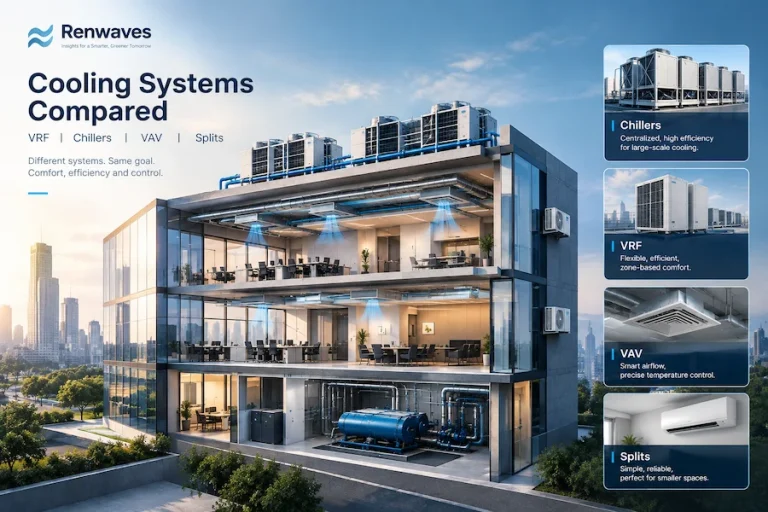
- VRF: Refrigerant distribution with zone control.
- VAV: Varies airflow; not a heat source.
- Ducted split: Air distribution; heating depends on the model.
Heating systems at a glance
| System | Typical fit | Efficiency potential | Upfront cost | Main limitation |
|---|---|---|---|---|
| Air-source heat pump | Homes, small commercial | High; climate-dependent | Medium–high | Cold-weather capacity; outdoor unit |
| Ground-source heat pump | Long-life buildings, sites with land | High and relatively stable | High | Ground loop cost and drilling |
| VRF / VRV heat pump | Offices, hotels, multi-zone buildings | High at part load | High | Refrigerant design and specialist service |
| Boiler + hydronic radiators | Existing radiator buildings | Varies by fuel and boiler | Low–medium for replacement | Combustion emissions or fuel dependency |
| Electric resistance | Small rooms, backup, occasional use | Nearly 1 kWh heat per kWh electricity at point of use | Low | Often high running cost |
| Furnace + ducts | Buildings with existing ductwork | Varies by fuel and equipment | Medium | Duct losses; fuel and ventilation needs |
| Central heat pump + VAV / air handling | Large commercial buildings | Depends on plant and controls | High | Complex design and commissioning |
| District heating | Dense urban areas with network access | Depends on network energy mix | Connection-dependent | Availability and tariff exposure |
Cost bands are qualitative, not quotations. Compare installed cost, annual energy use, maintenance, replacement cycles and local tariffs over the same analysis period.
How do the main heating systems work?
1. Air-source heat pumps
How they work: Transfer heat from outdoor air into the building using a refrigeration cycle. Reversible models can also provide cooling.- Strengths: High seasonal efficiency; no on-site combustion; available as ducted or ductless systems.
- Limitations: Output and efficiency fall as outdoor temperatures drop; defrost cycles and backup design matter in cold climates.
- Best for: Homes and smaller commercial buildings where electrical capacity, emitter temperatures and outdoor-unit placement are suitable.
2. Ground-source heat pumps
How they work: Exchange heat with the ground through buried loops or boreholes, where temperatures are generally more stable than outdoor air.- Strengths: Stable source temperatures; can offer strong seasonal performance and long equipment life.
- Limitations: Drilling or excavation increases initial cost; geology, site area and permitting affect feasibility.
- Best for: New builds, campuses and long-horizon projects where ground works are practical.
3. VRF / VRV heat pump systems
How they work: Modulate refrigerant flow between outdoor units and multiple indoor units. Heat-recovery configurations can move heat between zones at the same time.- Strengths: Independent zone control; modular layout; good part-load operation when correctly designed.
- Limitations: Refrigerant piping and safety requirements need specialist design; service and controls can be vendor-specific.
- Best for: Hotels, offices and mixed-use buildings with many zones and different schedules.
4. Boilers with radiators or underfloor heating
How they work: Heat water centrally and circulate it through emitters. Boilers may use gas, oil, biomass or electricity; system efficiency and emissions differ substantially.- Strengths: Familiar hydronic distribution; can suit buildings with existing pipework and high-temperature emitters.
- Limitations: Fossil-fuel models produce on-site emissions; boiler efficiency, fuel prices and future regulations affect lifecycle value.
- Best for: Existing buildings where replacing distribution is disruptive, or where a low-carbon heat source is not yet feasible.
5. Electric resistance heating
How it works: Converts electricity directly into heat at the point of use.- Strengths: Low equipment cost; simple installation; useful for small or rarely used spaces.
- Limitations: It generally delivers about one unit of heat per unit of electricity, while a heat pump can deliver more by moving heat.
- Best for: Supplemental heating, small rooms or situations where low first cost matters more than annual energy cost.
6. Furnaces and ducted warm-air systems
How they work: A furnace heats air, which a fan distributes through ducts. Heat may come from gas, oil or electricity; heat-pump air handlers can use the same distribution concept.- Strengths: Fast response; can reuse existing ductwork; forced-air systems can integrate filtration and ventilation.
- Limitations: Leaky or poorly insulated ducts waste energy; combustion models require safe venting and maintenance.
- Best for: Buildings with suitable ductwork or projects that need a combined air-distribution strategy.
Heating system comparison by decision factor
| Factor | Heat pump | VRF | Boiler + radiators | Electric resistance | Furnace / ducts |
|---|---|---|---|---|---|
| Heating source | Outdoor air / ground | Outdoor heat pump | Fuel or electricity | Electricity | Fuel or electricity |
| Zone control | Good with zoning | Very good | Good with valves | Room-level | Depends on zones |
| Cold-climate suitability | Model-specific | Model-specific | Usually strong if sized | Strong but costly | Usually strong if sized |
| Cooling capability | Often yes | Usually yes | Not alone | Not alone | Only with separate cooling |
| On-site combustion | No | No | Fuel-dependent | No | Fuel-dependent |
| Retrofit disruption | Low–high | Medium–high | Low if distribution stays | Low | Low–medium with ducts |
| Maintenance profile | Refrigerant + filters | Specialist service | Combustion + water circuit | Low | Combustion + ducts |
What about VAV, ducted splits and packaged units?
These terms are often compared with heat pumps, but they describe different design choices:
- VAV (variable air volume): A central air-handling system varies airflow to zones. Heating may be supplied by a central coil or terminal reheat. Performance depends on fan control, ventilation loads and reheat strategy.
- Ducted split: A split-system outdoor unit connects to an indoor air handler hidden above a ceiling or in a utility space. It may be a heat pump or cooling-only unit, so confirm the model and heating capacity.
- Packaged unit / rooftop unit: Heating and cooling components are combined in one cabinet. Common in commercial buildings where roof access and duct distribution are available. Efficiency and heating type vary by model.
- Chiller + boiler / heat-pump plant: A central plant serves many zones through water loops and air handlers. A chiller alone is normally cooling equipment; heat recovery or a heat-pump chiller can provide heating in suitable designs.
How to choose the right heating system
- Calculate the heat loss. Use room-by-room loads, design outdoor temperature, insulation, infiltration and ventilation requirements.
- Check the heat emitters. Heat pumps usually perform better with lower water temperatures; existing radiators may need resizing or envelope upgrades.
- Compare seasonal performance. Use seasonal metrics and climate-specific capacity data, not just a single peak COP value.
- Model total cost. Include installed cost, electricity and fuel tariffs, maintenance, replacements, incentives and carbon assumptions.
- Review electrical and site constraints. Confirm service capacity, outdoor-unit noise, clearances, refrigerant routing, drilling access and local codes.
- Commission the controls. Correct flow rates, weather compensation, zoning and balancing are essential to real-world performance.
Frequently asked questions
Is a heat pump better than a gas boiler?
It depends on climate, system temperatures, energy prices and the existing building. Heat pumps can deliver more heat per unit of electricity than resistance heating, but a fair comparison needs seasonal performance and local tariffs. A well-designed retrofit may require radiator or insulation upgrades.
Can a heat pump work in a cold climate?
Yes, if it is selected for the local design temperature and its capacity at low outdoor temperatures is checked. Some buildings need backup heat or a hybrid strategy during the coldest hours.
Is VRF the same as a heat pump?
No. VRF is a refrigerant distribution and control architecture. Many VRF systems are heat pumps, but the terms are not interchangeable.
Is VAV a heating system?
Not by itself. VAV controls how much conditioned air reaches a zone. The heating source may be a boiler, heat pump, central hot-water coil or terminal reheat.
What is the cheapest heating system to run?
There is no universal winner. Compare delivered heat cost using local energy prices and seasonal efficiency, while including maintenance and capital cost over the same period.
Sources and further reading
- U.S. Department of Energy. Air-source heat pumps and geothermal heat pumps.
- U.S. Environmental Protection Agency. ENERGY STAR heat pump guidance.
- ASHRAE. Standards and guidelines for HVAC design and system performance.
- U.S. Department of Energy. Furnaces and boilers.
- U.S. Department of Energy. Ductless mini-split systems.
- European Commission. Energy performance of buildings and EU building-efficiency policy context.
System capabilities and regulations vary by country and product generation. This article is an educational comparison, not a substitute for a building-specific design by a qualified HVAC professional.
- Calculate: Building heat loss.
- Compare: Local energy prices and seasonal efficiency.
- Include: Installation, maintenance and replacement costs.

I’m an engineer specializing in renewable energy technologies, with a master’s degree in mechanical engineering and research focused on thermo-photovoltaic systems. I’ve contributed to ISI journals, presented at international conferences, and written for industry publications, sharing insights on sustainable energy solutions.