
Split Cooler Sizing for Your Home: Step-by-Step Calculation With a Worked Example
Split cooler sizing comes down to one number: how much heat your room gains on the hottest day. For a 20 m² living room with one sunny west window and three people, that load is about 2.2 kW, or roughly 7,400 BTU/h.
The closest standard split air conditioner is a 9,000 BTU/h (0.75 ton) unit, not the 12,000 BTU/h model many people assume they need.
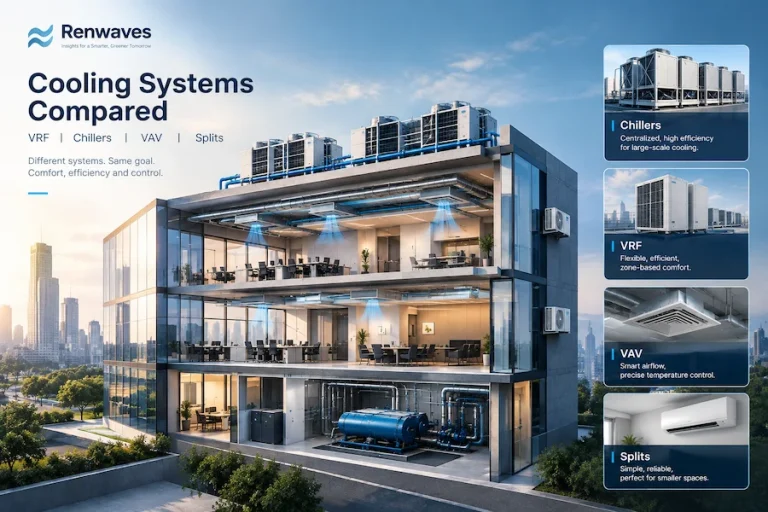
Below is the full calculation, one step at a time. It is a preliminary method, good for checking an installer’s quote or planning a purchase. If you are still deciding between a split and other systems, start with our cooling systems comparison.
⭐ Highlights
- Size for the heat, not just the floor area. Sun, windows, people, and appliances all add load.
- Bigger is not better. An oversized unit cycles on and off and leaves the room damp.
- Pick the nearest standard size up. Match your load to the unit’s capacity at your hot-day temperature.
What Is a Split Cooler and How Does It Work?

📘 Definition
A split cooler (split air conditioner) is a cooling system with an indoor unit that handles the room air and an outdoor unit that releases the heat.
Refrigerant circulates between the two units through thin copper pipes. The indoor coil absorbs heat and moisture from the room, and the outdoor condenser sends that heat out to the air.
Most new splits use an inverter compressor, which speeds up or slows down to match the load instead of switching fully on and off. That helps comfort and running cost, but it does not remove the need for proper sizing.
Why Split Cooler Sizing Matters
A unit that is too small never reaches the set temperature. A unit that is too large causes a different set of problems.
| Issue | Too small | Too big |
|---|---|---|
| Comfort | Stays warm | Uneven cooling |
| Humidity | Often fine | Clammy air |
| Running | Runs nonstop | Short cycling |
| Lifespan | Overworked | Frequent starts |
| Cost | High bills | Costlier unit |
⚠️ Caution
An oversized unit reaches the set temperature fast and shuts off before it removes much moisture. The room feels cold but sticky.
Design Inputs for the Example
We will size a split for a middle-floor living room in a warm climate. The inputs below are assumptions, so swap in your own numbers.
📘 Definition
Cooling load is the rate at which heat must be removed from a room to hold it at the set temperature. It is measured in watts or BTU/h.
| Parameter | Value |
|---|---|
| Room size | 5 × 4 m |
| Floor area | 20 m² |
| Ceiling height | 2.7 m |
| Outdoor design | 38 °C |
| Indoor target | 24 °C |
| Exterior wall | West, 13.5 m² |
| Window | 2 m², sunny |
| Occupants | 3 people |
| Floor and roof | Not exposed |
Step 1: Get a Quick Estimate From Floor Area
Before the detailed work, a floor-area estimate gives you a number to check against. Multiply the area by a typical load per square meter.
📐 Formula
Q_area = A_floor × q
| Climate | Load per m² |
|---|---|
| Mild | 90-100 W |
| Warm | 100-120 W |
| Hot | 120-130 W |
- Adopt 115 W/m² for a warm, sunny climate
- Q = 20 × 115 = 2,300 W
- Quick estimate: about 2.3 kW
Keep this value as a sanity check. The detailed steps below should land close to it.
Step 2: Calculate Heat Through Walls and Windows
Heat enters through the exterior wall by conduction, and through the glass by both conduction and direct sun. The sun is usually the biggest single item.
📘 Definition
Solar heat gain coefficient (SHGC) is the share of sunlight that passes through a window as heat. A lower number means less heat gain.
📐 Formula
Q_cond = U × A × ΔT
Q_sun = A × I × SHGC
- Net wall area: 13.5 − 2.0 = 11.5 m²
- Wall heat: 1.2 W/m²·K × 11.5 m² × 20 K = 276 W
- Window conduction: 2.8 × 2.0 × 14 = 78 W
- Window sun: 2.0 m² × 600 W/m² × 0.50 = 600 W
- Envelope subtotal: 954 W
The wall uses 20 K instead of the 14 K air temperature difference because the sun heats the wall surface well above the air. The U-values and the 600 W/m² sun intensity are typical assumptions. Use your own wall and glass data where you have it.
⚠️ Caution
The sun load assumes an unshaded west window. Curtains, blinds, or an overhang can lower it a lot.
Step 3: Add People, Lights, and Appliances
People and electrical devices release heat inside the room, so they count as part of the load.
- People: 3 × 120 W = 360 W (seated, includes moisture)
- Lighting: 10 W/m² × 20 m² = 200 W
- TV and electronics: 150 W
- Internal subtotal: 710 W
Step 4: Add Fresh Air and Air Leakage
Outdoor air that leaks in or comes in through ventilation brings both heat and moisture. Treat the two parts separately.
📐 Formula
Q_sensible = 0.335 × V × ΔT
Q_latent = 0.82 × V × Δw
Here V is the air flow in m³/h, ΔT is in °C, and Δw is the moisture difference in g/kg.
- Room volume: 20 × 2.7 = 54 m³
- Assumed leakage: 0.5 air changes per hour, so V = 27 m³/h
- Sensible: 0.335 × 27 × 14 = 127 W
- Latent (8 g/kg more moisture outside): 0.82 × 27 × 8 = 177 W
- Fresh air subtotal: 304 W
Step 5: Total the Load and Add a Margin
Add every source, then apply a small margin for uncertainty. About 10% is common for a home.
| Source | Load |
|---|---|
| Wall | 276 W |
| Window heat | 78 W |
| Window sun | 600 W |
| People | 360 W |
| Lights, devices | 350 W |
| Fresh air | 304 W |
| Subtotal | 1,968 W |
| Margin (10%) | 197 W |
| Total | 2,165 W |
The total of about 2.2 kW sits close to the 2.3 kW floor-area estimate from Step 1. That agreement is a good sign.
Step 6: Convert Units and Pick the Split Size
Split coolers are sold in BTU/h, kW, or tons, so convert your load to match the label.
| Unit | Equals |
|---|---|
| 1 kW | 3,412 BTU/h |
| 1 ton | 12,000 BTU/h |
| 1 ton | 3.52 kW |
- 2,165 W × 3.412 = about 7,400 BTU/h
- 7,400 ÷ 12,000 = about 0.6 ton
Now compare the result with common unit sizes. The bands below assume a warm climate, 2.7 m ceilings, and about 115 W/m². In a mild climate, you may need roughly 15 to 20% less.
| Unit (BTU/h) | Capacity (kW) | Room (m²) |
|---|---|---|
| 9,000 | 2.6 | Up to 20 |
| 12,000 | 3.5 | 20-30 |
| 18,000 | 5.3 | 30-45 |
| 24,000 | 7.0 | 45-60 |
The 2.17 kW load calls for the next size up, a 9,000 BTU/h unit rated at about 2.6 kW. That leaves roughly 20% spare capacity. Jumping to 12,000 BTU/h would mean about 60% extra, which is the oversizing trap from earlier.
⚠️ Caution
Rated capacity is measured at standard test conditions, often 35 °C outdoors. Output drops as it gets hotter, so check the manufacturer’s table at your design temperature.
Split Cooler Sizing Results at a Glance
| Item | Result |
|---|---|
| Quick estimate | 2.3 kW |
| Calculated load | 2.2 kW |
| Load in BTU/h | 7,400 |
| Load in tons | 0.6 |
| Chosen unit | 9,000 BTU/h |
| Unit capacity | 2.6 kW |
In this split-cooling-system sizing example, a 9,000 BTU/h inverter unit covers a 2.2 kW load with a sensible margin.
A typical inverter model of this size draws roughly 0.65 to 0.9 kW of electricity at full output, so check the nameplate of the model you pick. If you plan to run it on solar, our guide on how many solar panels you need is a good next read.
Adjusting the Result for Your Own Room
If you skip the full calculation, start from the floor-area estimate and apply these common adjustments.
| Condition | Adjustment |
|---|---|
| Very sunny room | +10% |
| Heavy shade | -10% |
| Kitchen | +1.2 kW |
| Extra person | +180 W each |
| Top floor | +10-20% |
| High ceiling | Scale by volume |
The extra-person figure applies to each person beyond two. The sun, shade, kitchen, and occupant values follow common ENERGY STAR room air conditioner sizing guidance, and the top-floor figure is a general rule of thumb.
Common Split Cooler Sizing Mistakes
- Sizing by floor area alone
- Choosing the biggest unit “to be safe”
- Ignoring west and south-facing windows
- Forgetting extra people or a kitchen
- Trusting rated capacity without checking hot-day output
- Expecting one indoor unit to cool several closed-off rooms
When to Bring In an Engineer
A hand calculation gets you into the right size range. For a whole house, several rooms, ducted systems, or unusual conditions, a full room-by-room load calculation such as ACCA Manual J is worth it.
Our team handles this kind of work as part of building energy simulation and efficiency consulting. You can see everything we offer on our services page. For larger buildings with a water-cooled plant, see our cooling tower sizing guide.
Split Cooler Sizing FAQs
How do I size a split cooler for my room?
Estimate the cooling load from floor area, walls, windows, people, appliances, and fresh air. Then pick the nearest standard unit above it.
How many BTU do I need per square meter?
About 90 to 130 W per m² (300 to 450 BTU/h), depending on climate, sun, and insulation.
Is a bigger split cooler better?
No. An oversized unit cycles on and off, cools unevenly, and removes less moisture.
Is a 1-ton split enough for my room?
A 1-ton unit (12,000 BTU/h or 3.5 kW) suits rooms of about 20 to 30 m² in a warm climate.
Do I size for heating too?
If the split is a heat pump, check its heating capacity as well. It can differ from the cooling rating.
Sources and Further Reading
- Energy Vanguard. HVAC load calculations, on ACCA Manual J and why sizing matters.
- ENERGY STAR. Room air conditioner sizing guidance, for kitchen and extra-occupant adjustments and the risks of oversizing.
- Natural Resources Canada. Guide to room air conditioners, for capacity adjustments by room use.
- ASHRAE. Standards and guidelines for HVAC system design.
Typical values for wall U-values, solar intensity, leakage rates, and unit efficiency vary by building and climate. This is an educational guide, not a substitute for a project-specific design.

I’m an engineer specializing in renewable energy technologies, with a master’s degree in mechanical engineering and research focused on thermo-photovoltaic systems. I’ve contributed to ISI journals, presented at international conferences, and written for industry publications, sharing insights on sustainable energy solutions.